
REVIEW · STOCKHOLM
Stockholm: Old Town and City Guided Walking Tour
Book on Viator →Operated by Vox City International Ltd · Bookable on Viator
Old Town has a way of making you slow down. This guided walk turns Gamla Stan into a story you can walk through, from royal landmarks to squares tied to major Swedish turning points. I like that you get both a guide’s live street talk and a Vox City app plan for what to see next.
Two things I especially like: the guide-led pace (you’re not just reading plaques) and the very “use what you learn” payoff from the app, with extra self-guided routes and lots of mapped stops. Guides I’ve heard of, like Laura and Ossi, are praised for being friendly and quick to steer the story toward what you’re most curious about.
One possible drawback: it’s about 2 hours on mostly outdoor streets, and entry into sights isn’t included. If you’re hoping to pop inside museums or cathedrals as part of the tour, you’ll need to do that on your own.
In This Review
- Key points worth your attention
- Why Gamla Stan works best on foot
- Meeting at Skeppsbrokajen: find your Vox City guide fast
- The “2-hour” promise: how the route keeps momentum
- Gustav III to Gustav II Adolf: rulers, power, and the cost of politics
- Parliament and the courts: power on display in the center of town
- Gamla Stan’s medieval skeleton: Västerlånggatan and the old defensive wall
- Riddarholm Church and the burial site story
- Stortorget and the Stockholm Bloodbath: the darkest square lesson
- Nobel Banquet and City Hall: when Stockholm turns ceremonial
- The Great Fire of 1625 and Stockholm’s later street life
- Ghost lore and witch trials: the Gray Man street vibe
- Swedish Academy and the Nobel Prize in Literature link
- Karl XIV Johan and the Gustav III obelisk: finishing with names you’ll remember
- The Vox City app: what you actually gain after the walking part
- Price and value: $34.70 for a guided intro plus an app
- Who should book this Stockholm Old Town walk
- Should you book this Stockholm Old Town and City guided walking tour?
- FAQ
- How long is the guided walking tour?
- What’s included with my ticket besides the guided tour?
- What languages are available for the audio commentary?
- Are entry tickets to attractions included?
- Where do I meet the tour?
- Can I cancel and get a full refund?
Key points worth your attention

- Live English guide plus multilingual audio (English, Italian, French, Spanish, German)
- Vox City app included: 5 free self-guided tours and 125 points of interest
- Starts at Skeppsbrokajen by the Gustav III statue and returns to the same spot
- Route hits major “big picture” landmarks: parliament, courts, Nobel sites, and City Hall
- Small-to-midsize group feel with a maximum of 99 travelers
- You’ll see famous spots tied to major events, including the Gustav III assassination and the Stockholm Bloodbath
Why Gamla Stan works best on foot

Gamla Stan is Stockholm in condensed form. You get tight streets, old stone, and landmark clusters that make more sense when you walk between them. A guided tour matters here because the names alone won’t explain why each corner felt important to Sweden’s rulers, courts, and elites.
This tour also gives you a smart balance: it keeps you moving through the medieval core, but it doesn’t ignore modern Sweden. You’ll see the seats of power—then you’ll see how that power connects back to the medieval streets and the people who lived alongside them.
And if you like “how did this happen” history, you’re in good shape. The tour highlights specific events—assassinations, fires, mass violence—without turning it into a gloomy lecture. It’s history you can connect to places.
You can also read our reviews of more walking tours in Stockholm


Meeting at Skeppsbrokajen: find your Vox City guide fast

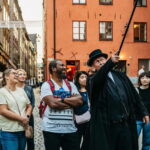
Start point is clear and practical: you meet at the Gustav III statue at Skeppsbrokajen, near Slottsbacken (right by the pier area). The tour departs from the pier below Slottsbacken, in front of the Gustav III Statue—easy to orient once you’re there.
Your guide will wear a dark blue Vox City Walks uniform and hold a sign with the VOX City logo. That detail sounds small, but it saves time when you’re traveling with limited patience (and limited daylight).
You also get a useful onboard rhythm: you’ll scan the QR code from your voucher to download the audio guide before you arrive. Bring your own phone for that step, since a mobile device isn’t included.
The “2-hour” promise: how the route keeps momentum
The tour runs about 2 hours. That timing is ideal for an Old Town intro because it hits big landmarks without turning into an all-day endurance event. It’s enough time to get your bearings, then go explore deeper on your own afterward.
The route is organized around a cluster of themes:
- Sweden’s political and royal story (opera and royal sites, the parliament area, courts)
- The Nobel/Civic Stockholm layer (Nobel-related stops and City Hall)
- Oldest-square and darker-street elements (major historic violence, witch-trial lore, eerie legends)
You’ll notice the walking stays focused on “see this, remember that.” You’re not just collecting photos—you’re building a mental map for later.
Gustav III to Gustav II Adolf: rulers, power, and the cost of politics
The first stops set a tone: this district wasn’t built for quiet strolls. You’ll pass the National stage for Swedish opera and ballet, founded in the 1700s by King Gustav III. The building’s connection to Gustav III’s assassination in 1792 is the kind of detail that changes how you look at ornate interiors—suddenly, it’s not just pretty. It’s political theater in stone.
Next comes a square named for Gustav II Adolf, often described as the Lion of the North. The walk links him to Sweden’s military power and to the story of the Vasa ship—again, a reminder that ambition in this country didn’t always stay on land.
If you’re the kind of traveler who likes understanding why buildings look the way they do, this segment is a win. It gives you names and stakes, not just dates.
Parliament and the courts: power on display in the center of town
One of the most useful parts of the tour is seeing how modern governance sits in the same walking world as medieval Stockholm. The Swedish Parliament building (Riksdag) is one of those places where the architecture alone won’t explain its role. On this walk, you get the idea of how it connects to other historic layers, including a mention of an underground passage to the Assembly Hall.
You’ll also hear about the Medieval Museum located beneath the bridge in that area. Even if you don’t go inside during the tour, this kind of “what’s under here” detail helps you later decide whether it’s worth a separate visit.
Then the tour shifts into the legal world with stops tied to Sweden’s highest courts. A former private residence turned into Sweden’s Supreme Court brings a personal-feeling twist: it’s not just grand state power, it’s also the conversion of private spaces into national authority.
For me, the biggest value of this stretch is that it makes Stockholm’s “power geography” make sense. You start to see the city as a system, not random landmarks.
You can also read our reviews of more guided tours in Stockholm





Gamla Stan’s medieval skeleton: Västerlånggatan and the old defensive wall
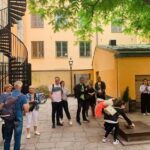
The walk spends time in the medieval streets where the city’s long timeline is visible. You’ll come across the idea that parts of this area have been inhabited for over a thousand years, which gives you context for why the street pattern feels so stubborn and old.
One highlight here is Västerlånggatan, a street that traces the line of the old defensive wall. That’s a satisfying detail because it turns a street you might otherwise ignore into something functional and historical.
This is also a nice moment to slow down for photos, since medieval cobbles and tight lanes are exactly what Gamla Stan does best. Just remember: cobblestones are still cobblestones. Wear shoes you trust.
Riddarholm Church and the burial site story
Riddarholm Church is one of those stops where you learn something and then immediately start scanning for clues you missed. It’s described as one of Stockholm’s oldest buildings and tied to the burial site for Swedish monarchs.
That monarch-burial connection changes the mood of the area. You stop seeing it as a church you pass and start seeing it as a place that holds national memory.
If you like the human side of history, this is a good point in the tour to pay attention. Even without going inside, the context makes the exterior feel like part of Sweden’s long official story.
Stortorget and the Stockholm Bloodbath: the darkest square lesson
The tour’s most intense historic stop is the oldest square in Stockholm, Stortorget. Here, you connect to the Stockholm Bloodbath of 1520, a major event that’s heavy by any standard.
There’s also a mention of a cannonball embedded in a building that’s said to symbolize the siege of 1521. That kind of physical detail is why guided tours work: it’s much easier to remember a landmark when it has a specific “why this matters” story attached.
This stop isn’t just for the history buffs. It’s for anyone who wants to understand how violent power shifts shaped the city you’re walking through.
Nobel Banquet and City Hall: when Stockholm turns ceremonial
Mid-tour, the energy shifts from royal and medieval to Nobel and ceremony. You’ll see the City Hall area and the famous Nobel Banquet connection, including the Blue Hall. You’ll also hear how City Hall is marked by three golden crowns, reminiscent of the Castle of Three Crowns.
If you’re planning to come back to City Hall later, this segment helps you decide what to prioritize. Knowing the Blue Hall connection and the visual crown motif makes it easier to recognize the significance fast when you return.
This is also where the tour becomes a practical “what’s important here” guide. Stockholm can feel orderly and polished, but this walk reminds you that even formal institutions grew out of older traditions of status and display.
The Great Fire of 1625 and Stockholm’s later street life
No Old Town walk is complete without fire and reinvention, and here you get the Great Fire of 1625. The mention of the district feeling lively today—paired with jazz bars like Stampen and boutique shops—keeps it from becoming a one-note history stop.
That pairing is smart. It lets you see Stockholm not as a museum piece but as a lived-in city where history and nightlife overlap. Even if you don’t plan to hang out afterward, it helps you frame your evening.
Ghost lore and witch trials: the Gray Man street vibe
The tour includes one of the older streets with a dark reputation connected to witch trials and ghost stories, including the Gray Man. Whether you take it literally or as folklore, it’s a fun way to break up the heavier political story beats.
This segment works especially well late in the walk, when you’ve absorbed enough facts to appreciate the theatrics of legend. It’s also a good reminder that Old Town’s identity isn’t only scholarly. It’s also storytelling.
Swedish Academy and the Nobel Prize in Literature link
Another high-interest stop is the Swedish Academy, the organization overseeing the Nobel Prize in Literature. Right from there, the Nobel connection expands to the Nobel Museum and Alfred Nobel’s legacy.
Even if you don’t go inside during the tour, this is the moment you can start planning. If you’re the type who wants to attach names to the awards you’ve heard about for years, this tour gives you the physical starting point.
Karl XIV Johan and the Gustav III obelisk: finishing with names you’ll remember
The tour wraps up with a photo-friendly finale: an obelisk dedicated by King Gustav III and a statue of Karl XIV Johan, a French general who became Swedish king.
Ending with a couple of major “recognizable” markers is a smart move. By this point, you’ve learned the story behind the district, and now you’re leaving with landmarks that feel easy to locate later.
The Vox City app: what you actually gain after the walking part
This is where the tour delivers value beyond the 2 hours. After you buy your ticket, you get access to the Vox City app, including 5 FREE self-guided tours and 125 points of interest across Stockholm.
The app also connects to other island and district areas like Kungsholmen and Djurgården, and it mentions key highlights such as the Royal Palace and the King’s Garden. That means the guided walk isn’t your only option—it’s your starter kit.
Think of it like this: the tour gives you the “why” behind Gamla Stan. The app helps you turn that understanding into smart next steps.
Price and value: $34.70 for a guided intro plus an app
At $34.70 per person for about 2 hours, the key question is what you’re really paying for. You’re paying for:
- live English commentary
- a structured walking route through major landmark clusters
- multilingual audio support
- and the Vox City app access with many extra points and self-guided tours
Since entry to attractions isn’t included, you’re not buying museum tickets. But you are buying orientation and context, which often saves time later and helps you choose what’s worth paying to enter.
Also, this is booked on average about 44 days in advance, which is a decent sign it’s a popular “easy win” tour slot.
Who should book this Stockholm Old Town walk
This tour fits best if you want:
- an Old Town intro that makes names and buildings click
- a guided story that’s timed to help you plan the rest of your day
- a mix of political history, Nobel/Civic Stockholm, and folklore flavor
It’s a great choice for first-timers in Stockholm who want to understand Gamla Stan fast—without turning the trip into a scavenger hunt.
It might be less ideal if you hate walking on cobblestones, or if you specifically want to go inside major sites during the tour, since entries aren’t included.
Should you book this Stockholm Old Town and City guided walking tour?
Yes, if you want a two-hour orientation that threads together Sweden’s royal story, its modern civic centers, and the Nobel-era Stockholm you see in photos. The combination of live commentary plus the Vox City app is strong value, especially if you plan to keep exploring right after.
Skip it only if your main goal is ticketed attractions and indoor time. This walk is built for seeing, learning the why behind it, and then using your own time afterward.
If you do book, show up on time at Skeppsbrokajen, download the audio guide via your QR code, and wear shoes you can trust on old streets. You’ll get more out of it, and your feet will thank you later.
FAQ
How long is the guided walking tour?
It runs for about 2 hours.
What’s included with my ticket besides the guided tour?
You get live English commentary, plus free access to the Vox City app, which includes 5 free self-guided tours and 125 points of interest. There is also multilingual audio commentary available.
What languages are available for the audio commentary?
Audio commentary is available in English, Italian, French, Spanish, and German.
Are entry tickets to attractions included?
No. Entry to attractions is not included.
Where do I meet the tour?
The meeting point is at the Gustav III statue at Skeppsbrokajen, 111 30 Stockholm. The tour departs from the pier below Slottsbacken, in front of the Gustav III statue, and it ends back at the meeting point.
Can I cancel and get a full refund?
Yes. You can cancel for a full refund if you cancel at least 24 hours before the experience’s start time. If you cancel less than 24 hours before, the amount paid isn’t refunded.