REVIEW · STOCKHOLM
Beautiful Stockholm Small Group Walking Tour
Book on Viator →Operated by Stockholm DriveAndGuide · Bookable on Viator
Stockholm does royal stuff very well. This small-group walking tour strings together the city’s power sites and old-street charm in just 1 hour 45. You’ll get clear explanations of what you’re seeing, from Baroque royal buildings to the way Sweden’s democracy evolved.
I like that it stays practical: you’re not wandering randomly, you’re following a logical route with great photo viewpoints along the way. Two highlights for me are the quick ramp-up of Swedish government history at the Parliament area and the walk through Gamla stan streets that still feel medieval in places. One thing to consider: it’s a walking tour, so on a windy or rainy day, you’ll feel it.
In This Review
- Quick hits (so you know what you’re getting)
- Royal Stockholm in 1 hour 45: the vibe and the value
- Meeting at Gustav Adolfs torg and ending by Karl XII and Kungsträdgården
- Stop 1: The Royal Swedish Opera and the royal face of Stockholm
- Stop 2: Riksdagshuset and how Swedish democracy changed
- Stop 3: Riksbron views—Knights Island, City Hall, and Nobel’s spotlight
- Stop 4: Lejonbacken photo spot, Royal Garden, and the Grand Hotel Nobel tie-in
- Stop 5: Slottsbacken, Palace Chapel, and Carl XIV Johan’s legacy
- Stop 6: Stortorget square and the Bloodbath of Stockholm
- Stop 7: Gamla stan lanes to Skeppsbron—medieval streets you can still walk
- Price and logistics: why this tour makes sense at this cost
- Small group, English guide, and what to expect from the pace
- Weather and what to bring for windy Old Town days
- Should you book this Stockholm small-group walking tour?
- FAQ
- FAQ
- How long is the Beautiful Stockholm Small Group Walking Tour?
- Where does the tour start and end?
- Is the tour offered in English?
- How big is the group?
- What kind of ticket do I need?
- Do I need to buy admission tickets for the stops?
- Is the tour near public transportation?
- Can I cancel and get a full refund?
- What fitness level do I need?
Quick hits (so you know what you’re getting)
- Small group of up to 10 keeps the pace friendly and questions possible
- Royal + government focus in under two hours, without feeling rushed
- Photo stops like Lejonbacken and Stortorget are built into the route
- Nobel Prize connections show up multiple times, including City Hall and the square
- Short, free-feeling stops at major exteriors and one palace chapel visit
- Visual aids from the guide make architecture and symbols easier to grasp
Royal Stockholm in 1 hour 45: the vibe and the value
This is a fast, well-paced way to get your bearings in Stockholm. You start with big ceremonial buildings tied to the monarchy, then you move into how Sweden governs itself today, and you finish in Old Town lanes where the city’s medieval layout still shows through.
At $106.42 per person, the value comes from focus, not volume. You’re paying for a guide to connect the dots—why these buildings look the way they do, who used them, and how Sweden’s political system changed over time. With a max group size of 10, you avoid the chaotic shuffle that can happen on larger tours.
If you love architecture, political history, or just want the shortcut to the “main scenes” without spending your whole first day figuring things out, this tour hits the mark.
You can also read our reviews of more walking tours in Stockholm
Meeting at Gustav Adolfs torg and ending by Karl XII and Kungsträdgården
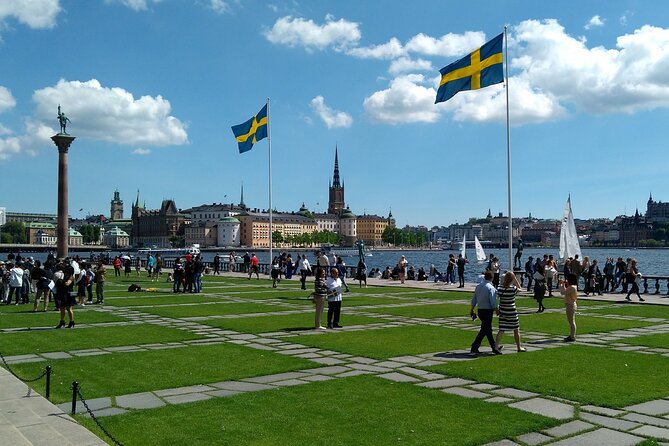
The tour begins at Gustav Adolfs torg (111 52 Stockholm). That’s a solid spot to meet because you’re near public transportation, and it puts you close to the royal-and-government axis.
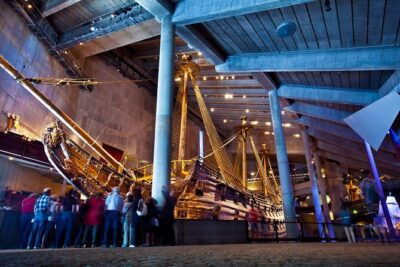
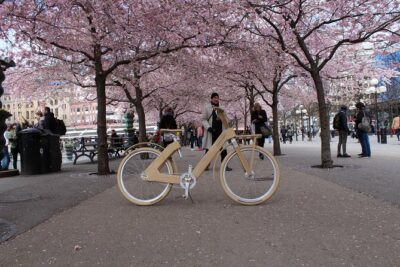
You finish near Karl XII’s statue and the southern edge of Kungsträdgården, a park right in central Stockholm. From there, it’s easy to keep exploring—there’s even a tram option to Djurgården, the museum island area (with Vasa, Viking, ABBA, and Skansen among others).
This start-to-finish flow matters. You’re moving through the city’s most “tell me where to look” zones in a way that makes sense for first-timers.
Stop 1: The Royal Swedish Opera and the royal face of Stockholm
You’ll start at the Royal Swedish Opera, and the guide sets the stage with Sweden and Stockholm basics. You’ll hear the formal name of the country—the Kingdom of Sweden—and you’ll learn how many nearby buildings connect back to royal life.
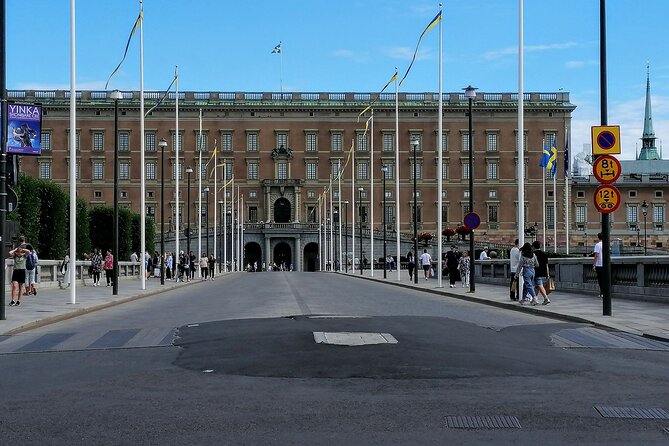
A key takeaway here is the Royal Palace fronting the square. You’ll be looking at its early 18th-century Baroque character. Even if you don’t go inside on this tour, the point is to understand why the area feels ceremonial: it was meant to project power.
You’ll also connect pop culture and classical music history. The opera building appears in the story of The Masked Ball, a Verdi opera centered on Swedish king Gustav III.
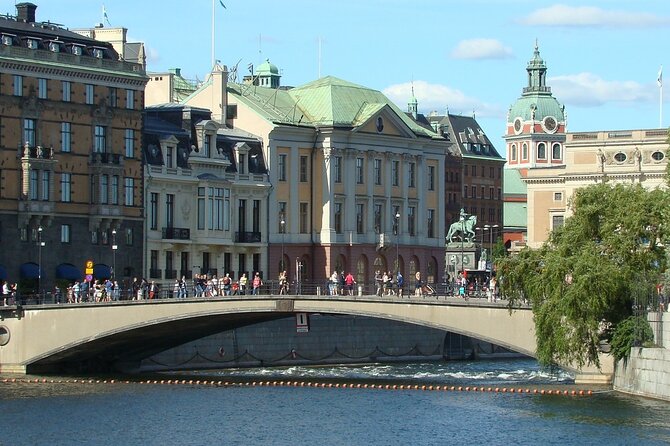
And across the square, you’ll notice the classic-style building now used by the Ministry of Foreign Affairs. The guide explains that it used to be the heir presumptive palace—a small detail, but it explains a lot about how these spaces evolved.
This stop is short, but it’s a helpful ignition point. You’ll leave it seeing the architecture as intentional, not random.
Stop 2: Riksdagshuset and how Swedish democracy changed
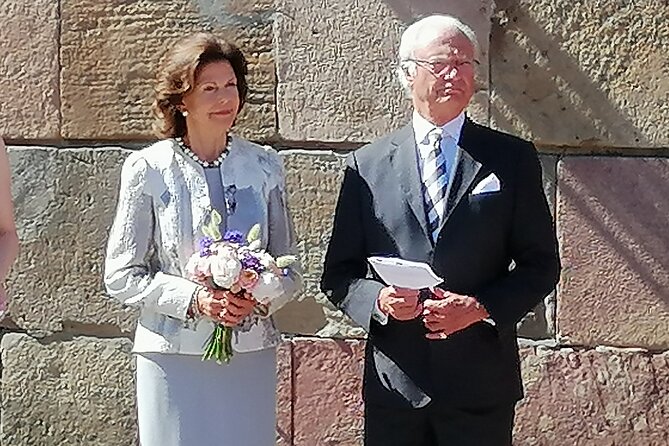
Next comes the Parliament Building (Riksdagshuset), built between 1897 and 1905 with Neo-Renaissance design and a Neo-Baroque facade section.
What makes this stop valuable is the timeline the guide lays out. You learn that before the current parliament, Sweden used the Riksdag of the Estates (Ståndsriksdagen) where the nobility, clergy, burghers, and peasants met in separate groups before coming together with the king. Then you hear how that system shifted.
A few dates that stick:
- 1866: the older institution was dissolved, and a parliament with two chambers was introduced, though voting wasn’t equal for all citizens.
- 1921: the first elections with general suffrage took place after a long political fight involving liberals and socialists.
- 1975: the constitution changed so the two chambers were merged into one, and it was confirmed the king has a representative role without real power.
This isn’t just “what building is this.” It’s how the country moved toward modern voting rights, framed in the spaces you’re standing near.
One practical note: since this is outdoors and timed (about 10 minutes here), don’t expect a slow, deep Q&A. Still, it’s enough time to get the key ideas.
Stop 3: Riksbron views—Knights Island, City Hall, and Nobel’s spotlight
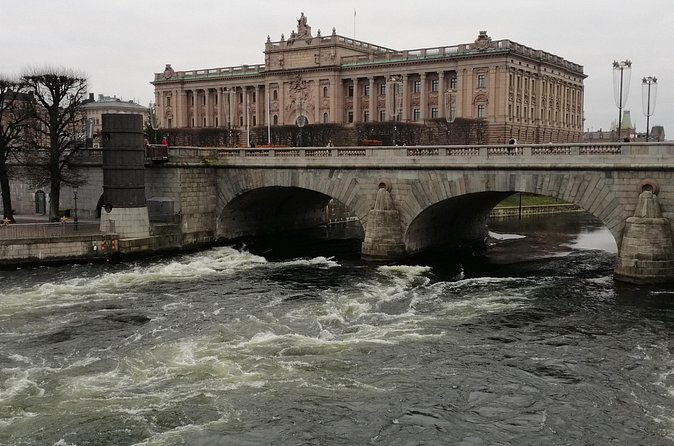
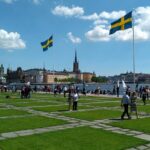
At Riksbron bridge, you get the best kind of break: you stand and look, while the guide points out the key landmarks lined up in the water-adjacent view.
From here you can spot:
- Knights Island
- the Prime Minister’s residence
- the Government building
- the House of Nobility
- and City Hall, where the Nobel Prize banquet happens each year
This is a great stop for two reasons. First, it gives you scale—you see how the government cluster relates to the rest of the city. Second, it keeps the tour from feeling like nothing but facades and statues.
If you like photos, this is a good spot to pause for a quick shot—especially if the wind isn’t trying to steal your hat.

Stop 4: Lejonbacken photo spot, Royal Garden, and the Grand Hotel Nobel tie-in
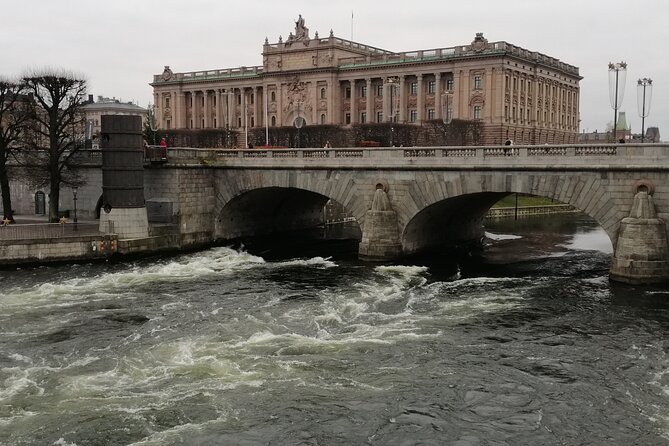
Now you move to Lejonbacken, on the north side of the Royal Palace. It’s one of the city’s most popular photo points for a reason: the angles work, and the backdrop is strong.
The guide ties the scene to Sweden’s time as a major Northern European power in the 17th and 18th centuries. You’ll see the Royal Garden and a statue of Karl XII, known as the last of the Swedish warrior kings. (Even if you don’t memorize the name, the lesson is clear: Sweden’s royal story isn’t just ceremonial—it’s tied to military prestige and national ambition.)
On the right side of the park, you’ll look toward the Financial District, built around the turn of the 20th century when architectural styles were blooming fast.
And then there’s the fun Nobel connection: you’ll see the Grand Hotel, the prestigious place where Nobel laureates stay during the ceremonies. It’s an easy detail to remember because it links “big institutional history” to something modern and global.
This stop is designed for photos, but the explanation makes it more than just postcard material.
Stop 5: Slottsbacken, Palace Chapel, and Carl XIV Johan’s legacy
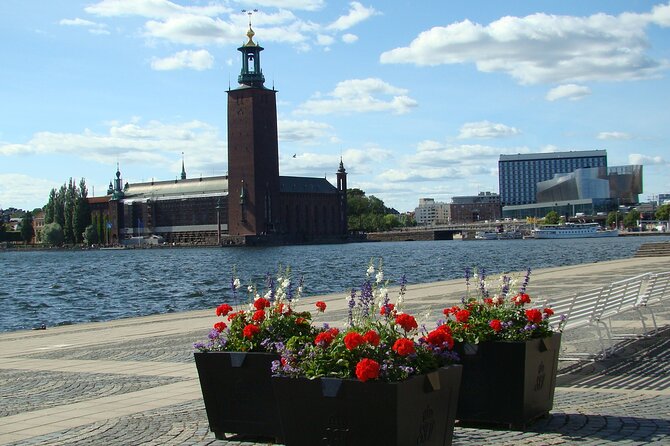
At Slottsbacken, you pass through the palace area and make a short stop at the Palace Chapel, where the royal family baptizes their children. It’s brief, but it gives the royal site a human rhythm—religion and family rituals, not just royal imagery.
Outside, you’ll see a statue of Carl XIV Johan. You get his career in plain terms: he rose in Napoleon’s army, later was adopted into the Swedish royal family, and became the first of the Bernadotte dynasty—still the ruling dynasty today.
The guide adds context that helps you understand Sweden’s shift after wars. Carl XIV Johan was brought in from France to help Sweden regain what it had lost to the Russians during the Napoleonic wars. Instead of focusing only on conflict, the story turns to diplomacy, building infrastructure, and developing education.
Then you get a “how modern Sweden got here” thread: in 2014, Sweden celebrated 200 years of peace, and the guide connects that to the industrial revolution, natural resources, and Swedish inventions helping create a foundation for a welfare state.
If you like tours that turn a statue into an idea, you’ll enjoy this stop.
Stop 6: Stortorget square and the Bloodbath of Stockholm
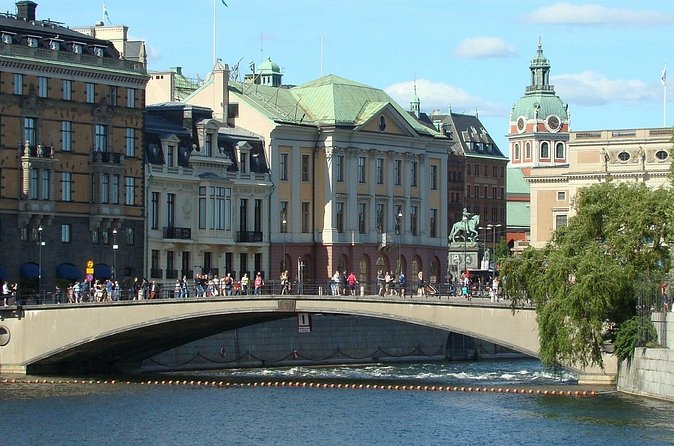
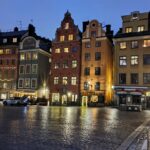
Stortorget is the central square in Old Town and one of Stockholm’s most photographed spots for a reason: the surrounding buildings mix 17th-century Scandinavian Renaissance and 18th-century Classicism styles. It’s a strong “you’re really in the old city” feeling without needing to squint at a single tiny landmark.
The guide also brings in one of the darkest stories tied to the square: the Bloodbath of Stockholm in November 1530, when around 100 noblemen and priests were beheaded by Danish king Christian II—who became known in Sweden as Christian the tyrant.
Right here, you also find the Nobel Prize Museum at Stortorget. The guide explains that Swedish Royal Academies and other committees choose Nobel winners across major fields in science and the arts.
This stop is a clever mix: beauty and cruelty, culture and politics, past and modern fame. And because it’s a square, you can pause easily if the day is cold or windy.
Stop 7: Gamla stan lanes to Skeppsbron—medieval streets you can still walk
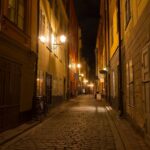
From Stortorget, you walk along Köpmangatan (Merchants Street), a street referenced in written material since 1350. The guide steers you into narrow alleys so you can actually feel how medieval Stockholm might have moved—tight lanes, turning corners, and the sense that the city wasn’t designed for cars.
You continue along Österlånggatan and down toward Skeppsbron. The highlight here is maritime: ships loaded cargo there starting in the 17th century. It gives Old Town a working-city vibe, not just an “old buildings for photos” vibe.
This last stretch is where the tour feels most like an experience. The earlier parts teach you what you’re seeing. This part shows you how the city fits together.
Price and logistics: why this tour makes sense at this cost
For $106.42, you’re buying:
- a structured route that covers the royal, political, and Old Town zones
- explanations of symbols, architecture, and political timelines
- a small group limit of 10 for a calmer pace
You’re not paying for museum tickets here in the usual way. Many stops are presented as free at the point of viewing or at least not ticket-heavy for the walking sequence. And the duration—about 1 hour 45—means you can fit it early in your trip without losing a whole day.
One fairness check: if you already know a lot about Swedish constitutional history or you hate walking in tight city spaces, you might feel the tour is “too broad.” But if you’re mixing sightseeing with learning, it’s a strong use of time.
Small group, English guide, and what to expect from the pace
The tour runs in English, and you’ll get a guide who makes architecture easier to understand. One nice sign: people note that the explanations come with visual aids, which matters when you’re looking at different styles—Baroque, Neo-Renaissance, Neo-Baroque—and trying to connect them to meaning.
The pace is manageable for moderate physical fitness. You’ll be on your feet, moving from stop to stop, with short pauses at each location. This is not a “sit down and listen for an hour” tour, but it also isn’t a hard hike.
Group size stays intimate: up to 10 travelers. That means you’re not stuck behind a moving wall of umbrellas, and you’re more likely to catch the key points.
Weather and what to bring for windy Old Town days
Stockholm weather can change fast. On windy days, the bridge and the open square spots can feel sharper than you expect. Plan for that.
Bring:
- a layer you can adjust quickly (wind-proof outer layer is useful)
- comfortable walking shoes for cobbles and narrow lanes
- sunglasses or a hat if the light is bright around the squares
Also, since this is centered in the old core and near major landmarks, you’ll want to dress for walking, not for standing still.
Should you book this Stockholm small-group walking tour?
Book it if you want a guided “fast track” through Stockholm’s most important visual and political sites—especially if it’s your first visit and you want to understand what you’re looking at. The combination of royal architecture, the Parliament story, and the Gamla stan lane walk is a smart way to get both context and atmosphere.
Skip it (or consider a different tour) if you’re not interested in Swedish governance and you’d rather focus only on museums or only on Old Town streets. Also, if you dislike outdoor walking in wind, plan your timing carefully.
FAQ
FAQ
How long is the Beautiful Stockholm Small Group Walking Tour?
It lasts about 1 hour 45 minutes.
Where does the tour start and end?
It starts at Gustav Adolfs torg, 111 52 Stockholm, Sweden, and ends at the Karl XII statue area, Karl XII:s torg 9, 111 47 Stockholm.
Is the tour offered in English?
Yes, the tour is offered in English.
How big is the group?
The tour has a maximum group size of 10 travelers.
What kind of ticket do I need?
You use a mobile ticket.
Do I need to buy admission tickets for the stops?
The stops listed are marked as having free admission tickets.
Is the tour near public transportation?
Yes, it is near public transportation.
Can I cancel and get a full refund?
Yes. Free cancellation is available up to 24 hours in advance of the experience for a full refund.
What fitness level do I need?
You should have a moderate physical fitness level, since it is a walking tour.