REVIEW · STOCKHOLM
3-Hour Private Walking Tour in Stockholm
Book on Viator →Operated by Amitylux · Bookable on Viator
Old Town Stockholm gets personal in three hours. This private walk for up to 10 makes the colorful streets feel like they come with footnotes, and I really like seeing Stortorget’s classic Old Town buildings and slipping into the angle-bent world of Mårten Trotzigs gränd. One heads-up: this tour doesn’t enter the major sights, so it’s for outside views and street-level stories, not museum time.
You’re also not stuck with a one-size script. An English-speaking local guide tailors the pace to your interests, and one guide named August is specifically praised for connecting how Stockholm grew with what you’re seeing right now. The possible drawback is simple: because the stops are quick, you need to be okay with lots of short scenes instead of slow, deep time in one place.
You start in the city center near Centralplan and spend about three hours moving through the core of Gamla Stan. If you want a tight “get your bearings fast” tour with a guide who can answer questions, this is a strong fit. If you’re hunting for long interior visits, you’ll want to plan extra time elsewhere.
In This Review
- Key things to know before you go
- Why a 3-hour private Old Town walk works in Stockholm
- Centralplan meeting point and Stortorget Square’s color punch
- Royal Palace area: power, symbolism, and St. George drama
- Stockholm City Hall and the three golden crowns
- Mårten Trotzigs gränd: the narrow alley moment you’ll remember
- Riddarholmen: the Knights’ Islet and the founding vibe
- Storkyrkan and the Saint George sculpture connection
- Nobel Prize Museum area: culture without the ticket pressure
- The Royal Opera House: a quick look at Stockholm’s cultural face
- Price and value: what you really get for $352.40
- Should you book this private Stockholm walk?
- FAQ
- How long is the 3-hour private walking tour?
- What does the tour cost?
- Is this tour private?
- What language is the guide?
- What’s included in the price?
- Are tickets into attractions included?
- Where do we meet for the tour?
- Is the meeting point near public transportation?
- What’s the cancellation policy?
Key things to know before you go
- Private group (up to 10): you’re not sharing the guide with strangers.
- Old Town, on foot: the focus is Gamla Stan landmarks and narrow street moments.
- No attraction entry: you’ll see key buildings and statues, but you won’t go inside.
- English-speaking local guide: built for Q&A and a tailored route.
- Tight timing: about ten short stops over roughly three hours.
- Well-liked experience: rated 4.9, with 96% recommending it.
Why a 3-hour private Old Town walk works in Stockholm
Stockholm can feel like a “big postcard” city at first. That’s exactly why I like this format: you get a guided route through the heart of Old Town without spending half the day figuring out where everything is. Three hours is long enough to connect dots, but short enough that you don’t burn daylight.
The private setup is a real advantage here. On a small group walk, you can ask more specific questions and the guide can adjust on the fly. That matters in Gamla Stan, where the stories are tied to tiny streets, not just big monuments.
Also, the route is designed to hit a handful of iconic symbols in a single sweep: square, palace area, city administration, a famously narrow alley, two major church landmarks, and a couple of cultural institutions. You’ll leave with a mental map, plus enough context to make later wandering feel smarter.
You can also read our reviews of more walking tours in Stockholm

Centralplan meeting point and Stortorget Square’s color punch
You meet at Centralplan 15 (111 20 Stockholm). From there, the walk quickly lands you at Stortorget, the main square in the Old Town. This is where Stockholm’s “I’m old, but I’m proud” mood shows up instantly: the square is framed by colorful buildings that look like they’ve been posing for centuries.
You’ll get a solid chunk of time here (about an hour). That’s important because Stortorget isn’t just pretty. It’s the kind of space where you can feel how public life works—where a city gathers, notices you, and then moves you along to the next layer of the story.
After Stortorget, the pacing continues with quick, scenic stops. If you like history that you can point at—rather than history that lives only in books—this route keeps you pointed in the right direction.
Practical takeaway: arrive a few minutes early so you don’t feel rushed before the square time starts. This tour moves briskly, and your best experience comes when you start relaxed.
Royal Palace area: power, symbolism, and St. George drama
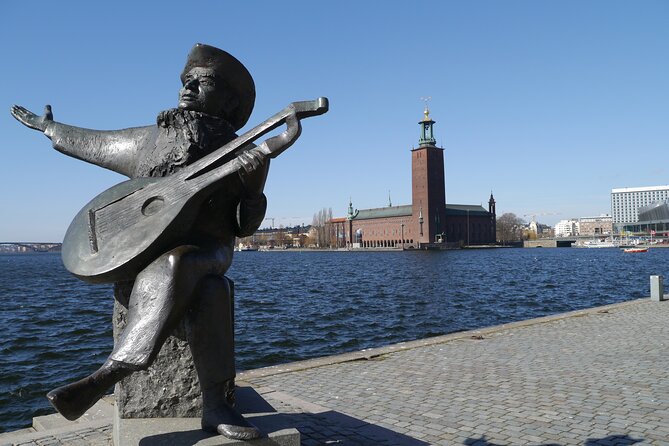
The Royal Palace is a centerpiece of the route. You’ll see it from the outside area first for about 30 minutes, then you’ll circle back for a short moment later. That second touch matters because it gives you another angle on the “palace as symbol” idea, not just the postcard look.
You also encounter the Statue of St. George—famous for the battle between St. George and the dragon. This isn’t a random fairy-tale stop. In Stockholm’s Old Town, the Saint George theme shows up again around the city’s main church area. Seeing it twice helps you notice the repetition of symbols across places.
Here’s what I like about this part of the walk: it balances big authority with story-driven details. The palace area tells you about power and governance, while St. George gives you a cultural thread you can carry forward to the churches and the religious art nearby.
One drawback to keep in mind: this is sightseeing without entering the palace complex. If you’re hoping to tour interiors, plan a separate stop. This walk is built for orientation and atmosphere.
Stockholm City Hall and the three golden crowns
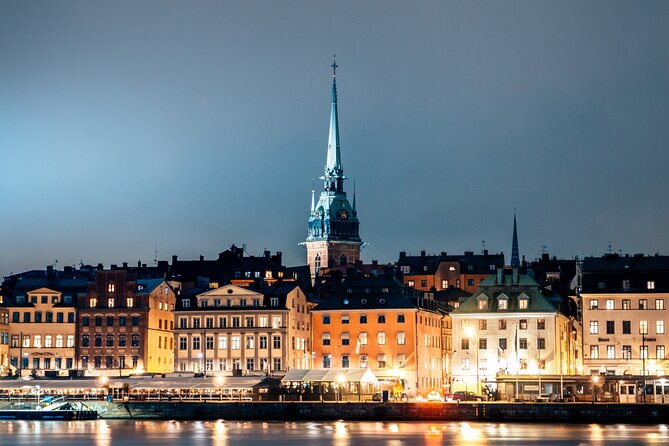
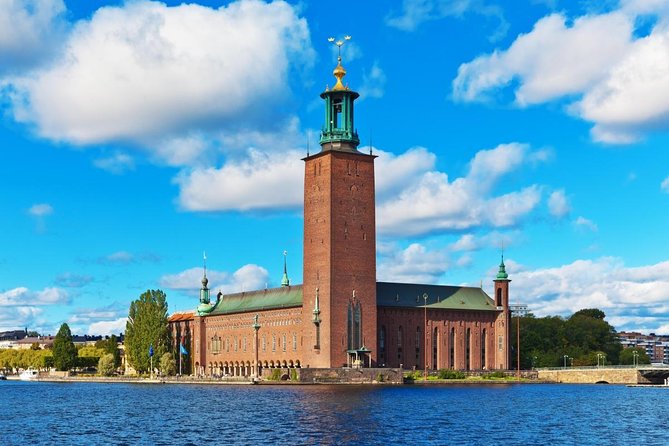
Next up is Stockholm City Hall, the building crowned by three golden crowns—an instantly recognizable symbol of Sweden. You get about 15 minutes here, which is just enough time to take in the exterior presence and let the guide connect the building to modern civic identity.
This stop works especially well if you’re the type who likes “how a place explains itself.” City Hall can feel abstract from a distance, but on a short guided walk, you’ll get the story behind why it’s such a visual icon.
One more smart aspect: you’re not staring at one building and forgetting the city around it. This route keeps you moving through layers of Stockholm—royal, civic, and street-level—so the city doesn’t turn into a single sightseeing blur.
Mårten Trotzigs gränd: the narrow alley moment you’ll remember
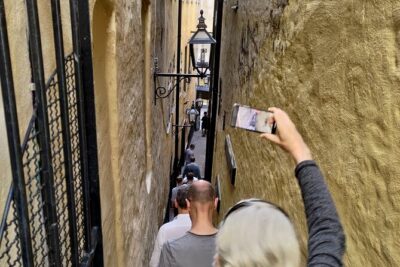
Then comes the real personality test for Gamla Stan: Mårten Trotzigs gränd, the narrowest alley in Stockholm. You’ll spend only about five minutes here, but don’t let that fool you. Small stops in Old Town can be the best ones because they teach you something fast.
Standing in a narrow passage like this changes your sense of scale. Suddenly the city feels less like a model and more like a place where everyday movement happened through tight squeezes and clever routes. It’s also a great photo stop, because the perspective does the work for you.
If you only “see” Stockholm from wide viewpoints, you miss this kind of detail. This is the opposite: you experience Stockholm by standing where it literally gets tight.
Tip for getting the most from that short window: pause, look both directions, and pay attention to how the street forces perspective. It’s one of those small moments that makes the larger Old Town story click.
You can also read our reviews of more private tours in Stockholm






Riddarholmen: the Knights’ Islet and the founding vibe
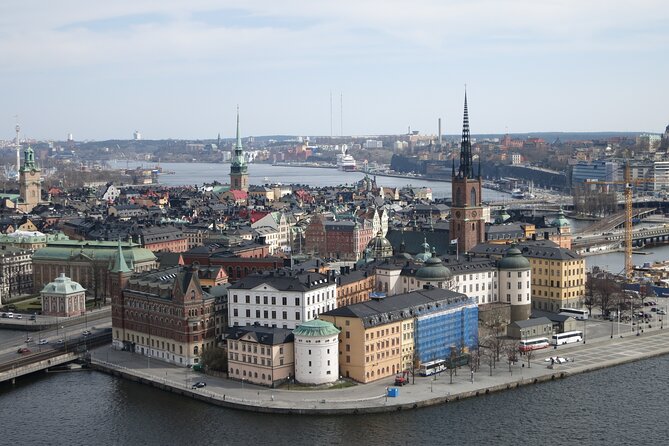
You’ll then reach Riddarholmen, the Knights’ Islet. This is a fast stop (about five minutes), but it’s framed as a place tied to how Gamla Stan was founded. The guide context is key here—without it, islet viewpoints can feel like “pretty scenery.” With it, the scenery turns into a clue.
Riddarholmen also has its own palace connection—described as the first one in Stockholm in this area. That kind of detail helps you understand why certain spots matter, even if they’re not the biggest buildings on the walk.
This part of the route is for people who like seeing how a city’s layout reflects its origin story. You’ll likely walk away with a more concrete mental image of how Stockholm’s center took shape.
Storkyrkan and the Saint George sculpture connection
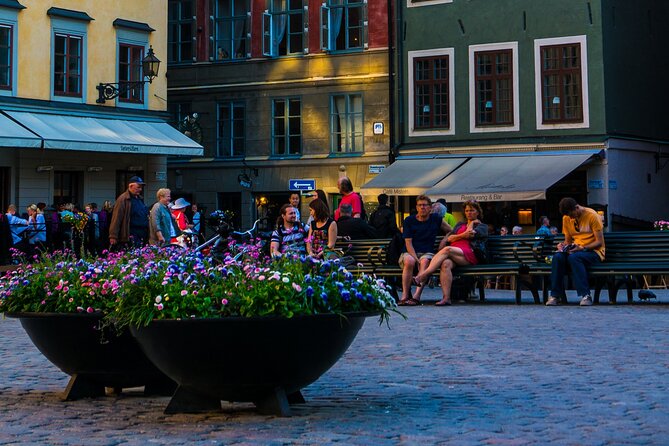
Storkyrkan (St. George’s Cathedral area) is another key stop. You’ll have about five minutes here. The church is described as the main church of Gamla Stan, and it’s linked to Saint George and the dragon sculpture—tying back to the earlier statue you saw.
That repetition is smart tour design. Seeing St. George in two different contexts lets you connect the theme across public art and religious art. Even in a short visit, you start noticing how Stockholm reuses important symbols.
This is also where the tour becomes less about “names of buildings” and more about “what people believed and valued.” If you’re a fan of meaning in everyday urban scenes—rather than only architecture—this stop is one of the more satisfying ones on the route.
Nobel Prize Museum area: culture without the ticket pressure
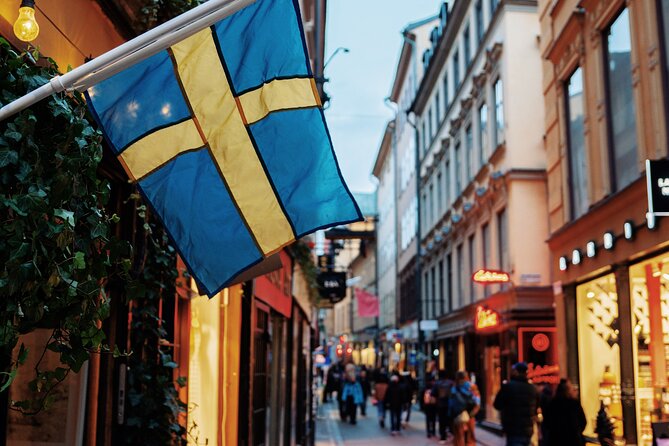
The route includes a stop connected to the Nobel Prize Museum and the Swedish Academy, with a focus on where the literature prize is decided. You’ll spend about 10 minutes in this zone.
Because you’re not entering attractions during the tour, this stop works differently than a museum visit. Instead, it’s a chance to connect a modern global institution to the neighborhood that hosts it. Stockholm does that well: international prestige sits in a city that still feels human at street level.
If you want interior museum time, you’ll need to add that separately. But if you’re the kind of person who likes context—knowing what you’re looking at and why it matters—this short cultural stop adds more than you might expect.
The Royal Opera House: a quick look at Stockholm’s cultural face
Finally, you’ll pass the Royal Swedish Opera (about 15 minutes). It’s another exterior-oriented moment—no entry—so it’s about spotting the building’s presence and letting the guide frame what it represents.
Opera houses in cities like Stockholm act as cultural landmarks. Even if you don’t attend a performance, you start recognizing how the city’s public life moves from squares and palaces to the arts.
This makes the end of the walk feel like a shift. You’ve covered authority (royal), governance (city), symbolism (St. George), and cultural credibility (Nobel and opera). That arc is exactly what you want from a short Old Town tour.
Price and value: what you really get for $352.40
The price is $352.40 per group, up to 10 people, for about three hours. The value equation depends on how you travel.
- For small groups (two or three people), it’s a premium experience. You’re paying for a guide’s time plus private pacing.
- For larger groups up to 10, it becomes more like “price per person you can live with,” since you share the cost.
What makes it feel worth it, for the right group, is the mix of things you can’t always guarantee on a standard public walking tour: a private setup, an English-speaking local guide, and a route built around iconic Old Town scenes. You’re also not paying extra for attraction entry during the walk—admission tickets for these stops are listed as free, but the tour doesn’t include actually going inside.
One more value point: this experience is booked far in advance on average. That’s a hint it’s popular for a reason—people want a reliable way to orient themselves in Stockholm’s core.
Should you book this private Stockholm walk?
Book it if you want a tight, guided Old Town orientation with real symbol connections—Stortorget to palaces, St. George recurring through the area, a famous narrow alley, and quick stops that make Nobel and opera feel less random. It’s also a good choice for groups who want privacy and the ability to steer the conversation.
Skip it (or pair it with extra plans) if you mainly want interior visits and long museum time. This is built for outside views and street-level stories, and the short stop lengths are part of the design.
If you do book, the best move is simple: tell your guide what you care about most—art, politics, legends like St. George, or city evolution. On a private walk, that kind of direction is how you turn a good route into a great one.
FAQ
How long is the 3-hour private walking tour?
It lasts about 3 hours.
What does the tour cost?
The price is $352.40 per group (up to 10 people).
Is this tour private?
Yes. It’s a private tour/activity, and only your group participates.
What language is the guide?
The tour is offered in English with an English-speaking local guide.
What’s included in the price?
An English speaking local guide is included, and you’ll have a mobile ticket.
Are tickets into attractions included?
No. Tickets into attractions/venues are not included, and the attractions are not being entered.
Where do we meet for the tour?
The meeting point is Centralplan 15, 111 20 Stockholm, Sweden.
Is the meeting point near public transportation?
Yes, it’s near public transportation.
What’s the cancellation policy?
Free cancellation is available up to 24 hours before the experience’s start time for a full refund, based on local time.